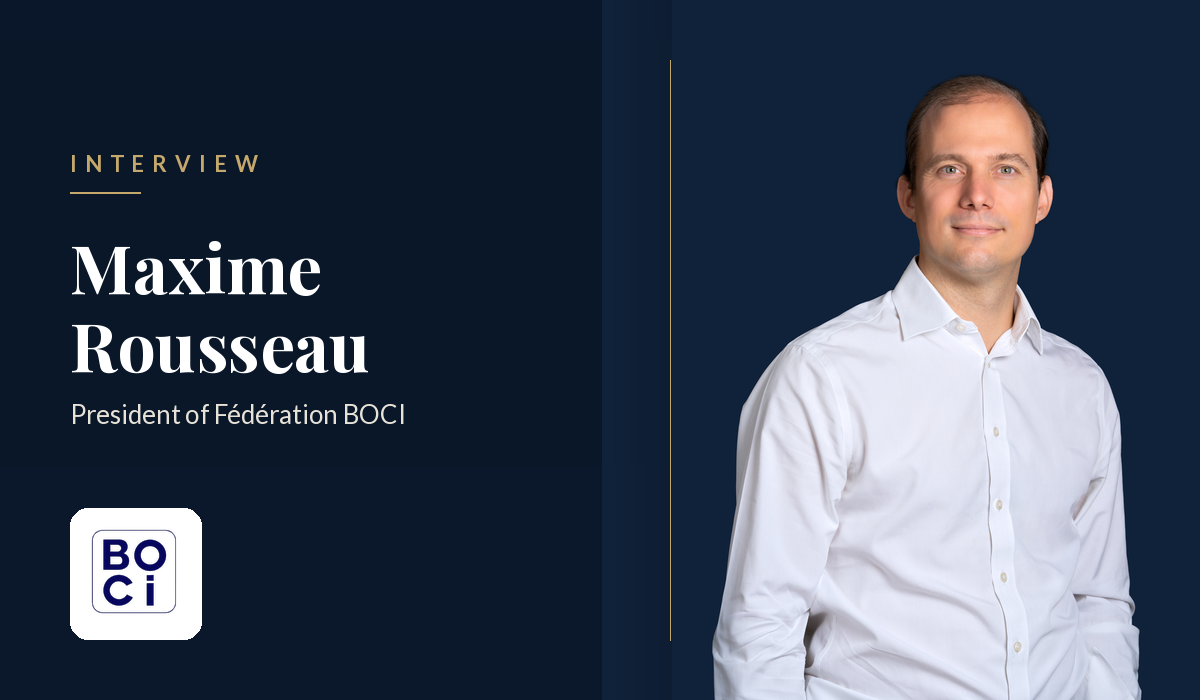
At a time when the French jewelry industry is facing unprecedented economic, regulatory, and competitive challenges, BOCI enters a new chapter with the election of its new President, Maxime Rousseau. A manufacturer, entrepreneur, and committed board member for several years, he takes on the role with a clear ambition: to strengthen the industry’s voice, unite its stakeholders, and help shape its future. In this exclusive interview, he discusses the motivations behind his new role, the priorities of his presidency, and his vision for an industry that must continue to protect its craftsmanship, promote quality, and reinvent the customer experience around jewelry.

You run La Coque de Nacre and have served as BOCI’s treasurer since 2023. What made you want to take the step toward the presidency?
La Coque de Nacre has been a BOCI member for more than 35 years. It was through my role as a board member that I truly came to understand BOCI’s mission.
I was able to appreciate the crucial role played by professional federations, and BOCI in particular, in bringing together designers, manufacturers, and all stakeholders across the industry while defending the interests of the sector as a whole. I fully committed myself to my responsibilities as a board member, working to support the entire industry and to contribute to BOCI’s transformation under the leadership of Valérie Dassa. The other members of the board then asked me to take on the presidency to ensure continuity in the transformation that began several months ago.
As a fashion jewelry manufacturer, how do you view the issues specific to this segment, which often gets less attention than fine jewelry?
Unfortunately, very few people can afford fine jewelry.
It is therefore only natural and historically consistent that the highest sales volumes in France are found in fashion jewelry, which remains at the heart of the French jewelry industry.
The sharp rise in precious metal prices has, of course, significantly increased manufacturing costs. At the same time, declining purchasing power is putting pressure on consumer spending, particularly on products considered non-essential.
The large number of emerging brands demonstrates the creativity and vitality of our market segment.
The massive (and not always fair competition) from online marketplaces represents both a threat and an opportunity. While these platforms put pressure on our businesses, the standardization of the products they offer is also encouraging consumers to seek originality and authenticity from fashion jewelry designers.
You mention having “actively contributed to the organization’s transformation” as treasurer. Concretely, what projects did you lead?
We streamlined our cost structure and simplified the way the organization operates by conducting a thorough review of every expense line.
The main initiative I led as a board member was defending the interests of our profession with public authorities, which repeatedly introduced so-called “simplification” measures that would have been detrimental to our industry.
I was also the board member responsible for promoting and protecting legally recognized product designations and ensuring regulatory compliance on major online platforms, as well as across the profession more broadly. Too many players, whether knowingly or not, use misleading product descriptions that do not reflect reality. This undermines the market and is ultimately harmful to everyone in the industry.
You describe BOCI as “a formidable and legitimate forum.” What, in your view, sets a professional federation apart from a simple union or lobby?
A lobby defends particular interests, whereas a professional federation represents an entire industry in an impartial way. As board members, we volunteer our time to promote, develop, and defend initiatives that benefit the whole sector, even when they do not directly serve the interests of our own companies.
In this respect, BOCI is exemplary. Despite its limited resources, it manages essential initiatives such as social dialogue, overseeing the Fashion Jewelry Specialization Certificate (formerly the complementary qualification), serving as the industry’s main regulatory contact for public authorities and, hopefully soon, developing B2B training programs.
You use strong words: “unite, energize, and reenchant.” Why this vocabulary, almost emotional, to describe a professional organization?
Today’s economic and political environment offers little reason for optimism. The prolonged downturn is putting many businesses, including long-established and resilient ones, under considerable pressure.
That said, we should never lose sight of the fact that we have a wonderful profession. We are fortunate to help make people happy. Our jewelry is part of life’s meaningful moments: gifts, expressions of gratitude, celebrations… We work in the world of beauty, craftsmanship, and tangible creations. We create with care, quality, and patience. Not everyone has that privilege.
In that sense, BOCI can be a place where members regain energy and optimism by reminding them of what makes our profession unique.
What, in the French jewelry industry today, most needs to be “reenchanted”?
Both the product offering and the customer experience. Jewelry retailers and designers are not machines.
We have the privilege of offering quality jewelry with genuine stories behind it.
To me, “reenchanting” means reinventing the way jewelry is sold. A store should not simply display brands side by side in a showcase.
Retailers and designers alike must rethink what makes them truly valuable and what differentiates them not only from other jewelry sales channels but also from competing industries such as perfume, cosmetics, restaurants, or leisure. We have everything we need to succeed in this transformation, with the support of Franceclat.
Among your five priorities, which feels most urgent in the short term, and why?
It’s difficult to choose just one, but I would say defending and representing our profession.
We live in a world that is moving ever faster, where everything is increasingly questioned, where ambiguity disadvantages businesses committed to quality, and where customers no longer always recognize the value of well-made products.
That is why clear communication is essential. Customers cannot value what they do not understand, whether that is quality, craftsmanship, or expertise, and if they do not value it, they will not be willing to pay for it.
You speak of “defending and representing the profession.” What regulatory or competitive challenges make the industry feel most vulnerable today?
The French authorities closely monitor established, financially sound businesses operating in France, while online marketplaces continue flooding the market with products advertised as silver, gold, gold-plated, vermeil, and so on, when they are often nothing of the sort, not to mention counterfeit goods.
This is not only a case of unfair competition; over time, it also damages the entire market because consumers become accustomed to disposable, low-quality jewelry and gradually lose any understanding of what quality jewelry really is.
If hallmarking standards and legally protected product designations (which exist to protect both manufacturers and consumers) are no longer respected, our industry is heading in the wrong direction.
On “investing in the future of the industry”: is your priority training, passing on craftsmanship, or industrial innovation?
Training and the transmission of craftsmanship.
You mention adjusting BOCI’s “economic model.” Does that mean rethinking membership dues, the services offered to members, or something else?
As mentioned earlier, membership fees have been standardized under a single scale for all members.
The services offered to members have not changed significantly so far, but we plan to introduce new ones and possibly discontinue others. It is a living portfolio of services that evolves according to our members’ needs and those needs naturally change over time.
You succeed Valérie Dassa after the statutes were overhauled in May 2026. What does this new governance concretely change in how the federation is run?
In practice, the federation’s day-to-day management remains largely unchanged. Daily operations continue to be handled by Emilie Kain Lacombre and her team.
Governance is provided by the Board of Directors, whose size has been reduced to make decision-making more agile and efficient.
We have also created working groups that will allow all members to contribute to or take ownership of key initiatives.
With this new, more streamlined board, what balance do you hope to strike between fashion and fine jewelry, between designers, brands, and manufacturers?
I’m not really sure how to answer that question, as these three dimensions are closely interconnected, and many businesses identify with all three at the same time.
Three years from now, at the end of your term, how will you know you’ve succeeded?
If we have successfully delivered our roadmap, improved training and information across the industry on the specific characteristics of our profession, and achieved better compliance with the rules that protect and uphold our craftsmanship, then I will consider the mission a success.
Is there a message you’d like to address directly to BOCI’s members, particularly the smaller businesses?
Promoting our industry requires everyone’s active and constructive participation. We need each member’s contribution within our working groups, not based on whether it directly benefits your own company or brand, but because it serves the industry as a whole.
Our sector will only become stronger through the cohesion of its members.
We have a wonderful profession, driven by remarkable people, and we help bring beauty and meaning into people’s lives. Despite today’s economic and political challenges, we have everything we need to successfully promote our expertise and craftsmanship. Get involved!